Force Sensor Market Development Analysis and Emerging Industry Trends
Key Highlights
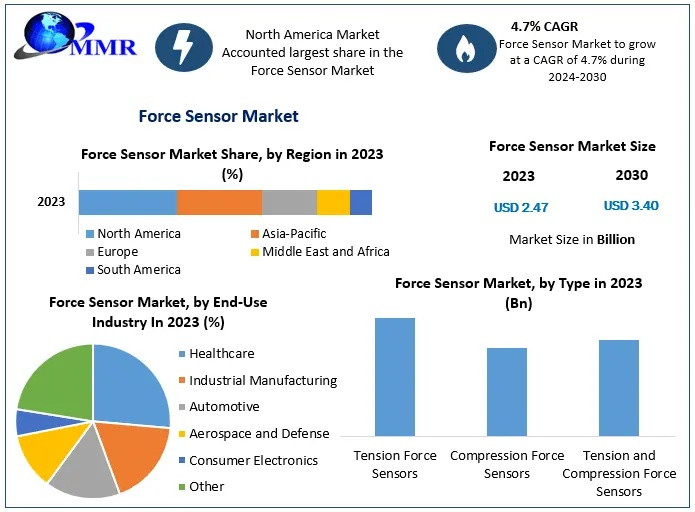
The Force Sensor Market was valued at US$ 2.47 billion in 2023, creating a substantial base for future demand.
Revenue is projected to grow at a 4.7% CAGR from 2024 to 2030, reaching nearly US$ 3.40 billion and indicating steady expansion.
Versatile applications remain a major growth driver, widening opportunities for sensor manufacturers.
Industrial automation and robotics are creating new use cases in assembly, inspection, packaging, polishing, and machine operations.
North America is expected to retain a significant share, with the United States identified as an important demand center.
Market Overview
The Force Sensor Market covers devices that convert tension and compression into digital signals for monitoring, processing, and machinery control. It includes tension, compression, and combined sensors, plus analog and digital operation and strain gauge, load cell, force-sensitive resistor, and other technologies.
This breadth gives suppliers multiple routes to address application-specific requirements across industrial and technology-driven environments.
Why This Market Matters Now
Manufacturing organizations use sensors to monitor force during production, while vehicles can use them to estimate axle loads and evaluate coupling behavior.
Meanwhile, Industry 4.0 is accelerating robotics adoption. Force and torque sensing can support robotic deburring, sanding, polishing, inspection, packing, and assembly. For buyers, this expands sensors from measurement components into tools for process control and productivity.
Access a Free Sample Report Copy : https://www.maximizemarketrese....arch.com/request-sam
Key Trends Driving Growth
Industrial automation is a central trend. Connected machines, robotics, and control systems increasingly use force feedback for precision tasks, creating opportunities for reliable sensing suppliers.
Application expansion is another trend. Healthcare, automotive, aerospace and defense, consumer electronics, and industrial manufacturing are all covered in the market structure. However, miniaturization remains a challenge because smaller sensors require extensive research and development and can increase costs.